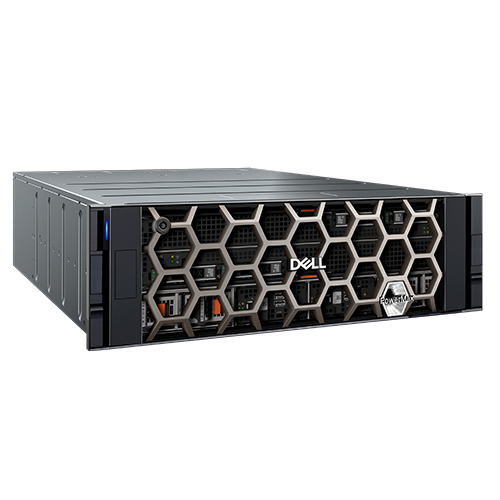
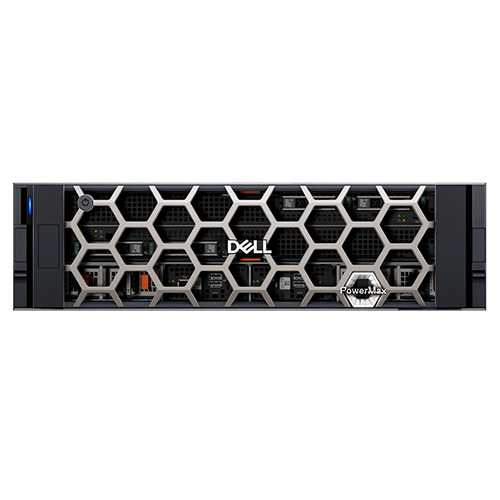
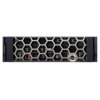
Dell PowerMax 2500 Mission-Critical Storage
Model: PowerMax 2500
Tech Specs
Processor
Intel Xeon, 2.8 GHz
Cores per Node/Array: Memory configs 1-3: 64/128
Cores per Node/Array: Memory config 4,5: 72/144
Functional
All-flash, end-to-end NVMe mission-critical storage
Unified support for block, file, mainframe, IBM i, and container-based workloads
Memory
Cache memory: 896 GB – 15.36 TB
System Overview
Base enclosure
3U enclosure with dual active/active nodes
2 to 4 NVMe SED Flash modules per node pair (vault drives)
Eight IO modules per node pair
Redundant and hot-pluggable power supplies and cooling fans
Expansion enclosures
2U dynamic media enclosure (up to two per array)
48 2.5” NVMe Flash drive slots
Affordable single-drive non-disruptive upgrades
Redundant and hot-pluggable power supplies and cooling fans
Expansion Capacity
Expansion method
Scale-up: 1 node pair plus 1 expansion enclosure
Scale-out: Up to two node pairs per array
Optional two-node pairs with a single drive enclosure
Per array
Max capacity: 8.8 PBe
Max drives: 96
Connectivity
Front-end network protocols
Block: FC, FICON, NVMe/FC, NVMe/TCP, iSCSI, SRDF
VMware : FC, NVMe/FC, iSCSI, NVMe/TCP, SRDF
File: NFSv3, NFSv4, NFSv4.1; CIFS (SMB 1), SMB 2, SMB 3.0, SMB 3.02, and SMB 3.1.1; FTP and SFTP
Front-end network ports per node pair
Max 16/32/64 Gb FC ports: 32
Max 10/25/100 Gb iSCSI ports: 32
Management ports
Dual 1Gbe ports
Media Types
NVMe SSDs
TLC drives:
3.84 TB
7.68 TB
15.36 TB
30.72 TB
QLC drives:
15.36 TB
30.72 TB
Software
All software required to store data and manage the system is included with each PowerMax purchase. PowerMaxOS upgrades are non-disruptive and take under six seconds.
Data Optimization
Efficiency
Thin provisioning
Thin clones
High-efficiency RAID (up to 92% efficient)
Data Reduction
5:1 DRR guarantee
Hardware-based compression
Global inline deduplication and compression
Manage data reduction by storage group
Data Protection
Local Protection
SED-based encryption with self-managed and external key management
Local Point-In-Time Copies (Snapshots and Thin Clones)
Immutable & Secure Snapshots
The industry’s most scalable cyber recovery, 65M Secure Snapshots per array
Remote protection
The gold standard in remote replication
Native Synchronous/Asynchronous Block Replication
Native Synchronous/Asynchronous File Replication
SRDF/Metro Smart DR (4-site replication optional)
Native PowerProtect Data Domain integration – manage local or multicloud backups from PowerProtect
Security
Security
US Department of Defense: Approved Products List, STIG hardening
Common Criteria
FIPS 140-3 for Data-at-Rest Encryption on TLC drives (optional)
(KMIP) compliant external key manager
IPv6 USGv6-R1 certification
Immutable Hardware Root of Trust, Secure Boot Chain of Trust
Digitally signed firmware updates
Multi-factor authentication via RSA SecurID and YubiKey
Single sign-on (SSO): Entra ID, Okta, PingFederate
Secure and immutable snapshots
Tamper-proof audit logs
Ransomware anomaly detection and alerting
PowerMax cyber recovery vault
Other compliance
Restriction of Hazardous Substances (RoHS) compliance
Secure TLS 1.3 communication
Management
PowerMax Unisphere Manager (GUI)
CLI, REST API
Dell AIOps for intelligent IT infrastructure insights
Proactive Assist: Configure remote support, online chat, open a service request, etc.
Quality of Service via Host I/O Limits
Syslog support (including alerts)
Power Consumption Dashboard (iPDU): rack-level power/environmental monitoring and alerting
Ecosystems
PowerMax supports a wide variety of protocols and advanced features available via various software suites and packs including but not limited to:
VMware
Dell Virtual Storage Integrator (VSI) for VMware vSphere™: For provisioning, management, and cloning
VMware Site Recovery Manager (SRM) Integration: Managing failover and failback making disaster recovery rapid and reliable
Virtualization API Integration: VMware: VAAI and VASA.
vRO Plugin for PowerMax
DevOps/Containers
Container Storage Interface (CSI) Plugin
Ansible Module
Terraform Provider
Dell Container Storage Modules: Authorization, Replication, Observability, App Mobility
Other
OpenStack Cinder Driver
Red Hat OpenShift Platform
Data Mobility
Native import/migration from other platforms
Dynamic Data Mobility: Block storage migrations to and from Dell and non-Dell storage arrays
RiverMeadow Cloud Mobility for Dell: Move workloads between PowerMax and any public cloud
Physical
System Bay 1, Single Node Pair, Single Drive Enclosure
Height: 199.2 cm / 78.4 in
Width: 60 cm / 23.5 in
Depth: 114.8 cm / 45.2 in
Max. Weight: 306 kg / 675 lbs
System Bay 1, Dual Node Pairs, Two Drive Enclosures
Height: 199.2 cm / 78.4 in
Width: 60 cm / 23.5 in
Depth: 114.8 cm / 45.2 in
Max. Weight: 408 kg / 900 lbs
Power
AC line voltage
200-240 VAC ± 10%, single phase, 50 to 60 Hz
200-240 VAC ± 10%, three-phase, 50 to 60 Hz
Maximum Power consumption
Single cabinet, Single Node Pair, Single Drive Enclosure
Typical operating temp (26°C): 2.213 kVA max at 200V-240V
Maximum operating temp (35°C): 3.131 kVA max at 200V-240V
Maximum Heat Dissipation
Single cabinet, Single Node Pair, Single Drive Enclosure
Typical operating temp (26°C): 7,551 Btu/hr max at 200V-240V
Maximum operating temp (35°C): 10,683 Btu/hr max at 200V-240V